
Adventure Motorcycle Riding in New Zealand: The Questions Riders Ask Most


What Australian riders asked us at ADV Fest - and what riders from around the world want to know too
When we took Rumbling Adventures New Zealand to ADV Fest in Dorrigo, NSW, in August 2026, we had plenty of conversations with Australian riders who were curious about what it's really like to come to New Zealand and ride.
But the questions we were asked aren't unique to Australian riders. We've had the same conversations with riders from all over the world who are interested in experiencing New Zealand's backcountry on two wheels.
What are the tracks actually like? How difficult is the riding? What bikes do you use? How remote do you go? Do I need to carry my luggage? What happens if I drop the bike? How far can we go between fuel stops?
Rather than answering the same questions one rider at a time, we've put the most common ones together, whether you're coming across the Tasman from Australia, flying in from Europe, North America, Asia, or somewhere else in the world.
Jump to a section:
What sort of riding do you actually do?
This isn't a road-tour holiday where you spend all day riding from one town to another on sealed roads.
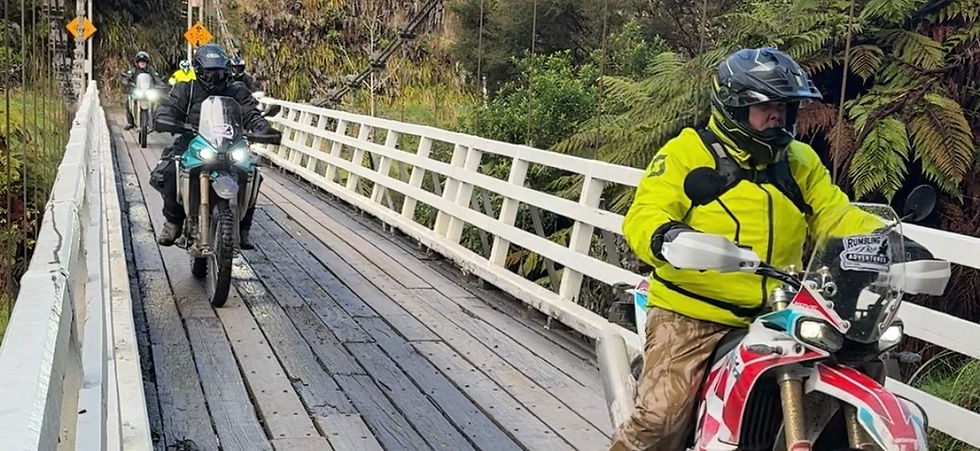
Our tours are built around adventure riding: gravel roads, backcountry tracks, forestry roads, farm tracks, mountain passes, river crossings, and some genuinely challenging terrain.
Many of our tours are 60% or more dirt and gravel, with the exact mix depending on the tour. You can spend a day riding through completely different environments without spending hours on a motorway — that's one of the big reasons riders come to New Zealand in the first place.
For Australian riders, it's a dramatically different riding environment just across the Tasman. For riders travelling from further afield, it's an incredible variety of terrain and scenery packed into a relatively compact country.
And because we ride these routes ourselves, we're not simply selling a line on a map. We know the terrain, we know how conditions can change, and we know that a route that looks straightforward on paper can be a very different proposition when you're actually sitting on a motorcycle in the middle of it.
How difficult is the riding?
This is probably the most important question, so we'll be straight with you.
Our tours are aimed primarily at intermediate to experienced adventure riders. They're not enduro races, but they're not beginner tours either. You should be comfortable handling an adventure motorcycle on gravel and uneven surfaces, with some off-road experience behind you.
Difficulty also depends heavily on conditions. A track that's straightforward in the dry can become a completely different proposition after heavy rain. Our guides assess conditions throughout the ride and make decisions based on what's actually happening that day, not simply what the map says.
The objective isn't to find out who's toughest. It's to have an adventure, ride incredible terrain, and get everyone home safely.
Do I need to be an expert off-road rider?
No.
But you do need to be a reasonably competent motorcycle rider who's comfortable off sealed roads - not a professional enduro rider.
Most riders who join us are experienced motorcyclists who want to try more challenging terrain and explore places they wouldn't normally ride on their own.
If you can ride confidently on gravel, stand on the pegs when required, and keep your head when the terrain gets interesting, you're already most of the way there.
What bikes do you use?
We've recently moved our fleet to Kove motorcycles, particularly the Kove 450 Rally and Kove 800X Rally.
The Kove 450 Rally in particular suits the riding we do extremely well, a genuine rally-style adventure bike with a large fuel capacity, long-travel suspension, and the range to handle everything from open gravel roads to technical backcountry.
We ride these bikes ourselves. We don't choose motorcycles because they look good on a spec sheet - we test them in the terrain our customers will encounter and make changes where we believe those changes will improve the experience.
The motorcycles in our fleet have to work in the real world.
I'm only 5'3" - can I ride a Kove 450 Rally?
We hear this a lot.
The Kove 450 Rally is available with a 910 mm lowered seat height, which makes it considerably more approachable for shorter riders than the standard version.
We're also trialling a lowering link on a Kove 450 Rally this season, to see whether it holds up to our handling and suspension standards - it'll only join the fleet if it does.
Seat height is only part of the equation, though. Rider confidence, suspension setup, technique, and how comfortable you are putting a foot down all matter too.
If you're worried about your height, talk to us before booking. We've had riders assume a bike would be too tall for them, only to find that it worked fine once they actually sat on it.
How many kilometres do you ride each day?
It depends on the tour and the terrain.
Some days involve a lot of distance on flowing gravel roads. Others cover fewer kilometres because we're tackling technical terrain, crossing rivers, stopping for photos, or navigating remote backcountry.
We don't measure a good day by how fast we got from A to B. The route is part of the experience.
A 200-kilometre day on fast gravel can feel very different from a 120-kilometre day involving difficult terrain, river crossings and constant changes in surface.
What about fuel and range?
Fuel is included as part of your tour - you won't need to budget or plan for it separately.
We take care of the fuel planning, particularly when we're riding in remote country.
The Kove 450 Rally's large fuel capacity is one of the reasons it suits the type of riding we do, but our routes are also planned around fuel availability, distance and conditions well in advance.
Remote riding means you can't always assume the next fuel station will be where your GPS says it is, so we don't leave that to chance.
You ride. We take care of the logistics.
Do I have to carry my own luggage?
It depends on the tour.
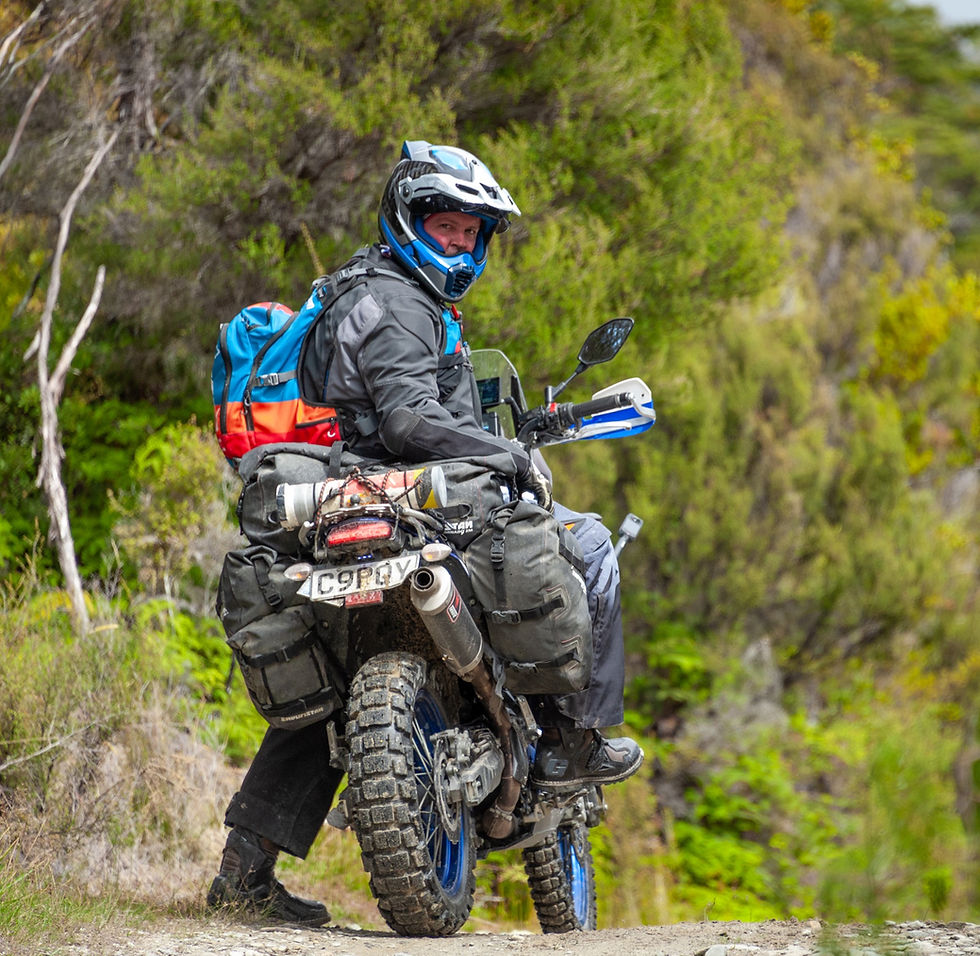
Some of our tours are fully supported, with a support vehicle carrying your main luggage. Others are deliberately more self-contained, with riders carrying their own gear in supplied soft luggage.
For example, our 5 Days of Dirt is designed as a more self-contained adventure, with riders carrying their own luggage. Other tours use a support vehicle so you can ride without carrying your main luggage on the motorcycle.
Check the individual tour before booking so you know exactly what's included, or ask us and we'll point you towards the tour that best matches what you're looking for.
What happens if I drop the bike?
You're riding a motorcycle in the dirt.
Drops happen.
We're far more concerned with looking after the rider than pretending motorcycles never fall over.
Our tours include a motorcycle damage bond, with the terms explained before you ride. We also carry mechanical and first-aid equipment and have procedures for dealing with incidents in remote areas.
The important thing is that you understand the terms before you arrive - no surprises.
Are the motorcycles insured?
Yes, as part of the tour package.
There are conditions, exclusions, and excess/bond arrangements, though, so you should read the full terms before booking.
Insurance protects you against certain risks. It isn't a licence to ride like a lunatic.
What licence do I need to ride in New Zealand?
You need to hold the appropriate motorcycle licence or riding entitlement for the motorcycle you're riding.
If you're travelling from overseas, the exact requirements can depend on your home licence and the rules that apply to visitors.
If you're unsure whether your licence allows you to ride one of our motorcycles in New Zealand, ask us before booking. It's much easier to sort out the details before you arrive than after you've landed.
What riding gear do I need?
You need to bring your own appropriate motorcycle riding gear:
Motorcycle helmet
Riding boots
Gloves
Protective riding jacket and pants
Body protection appropriate to your riding
Waterproof or weatherproof outer layers
Clothing suitable for changing conditions
New Zealand weather can change quickly, particularly in the mountains and backcountry. You don't need to bring camping equipment for our normal tours, but you do need to come prepared for the conditions you're likely to encounter.
If you're unsure about what to pack, ask us before you travel.
Please check our recommendations on what to wear at Layered for Adventure
What happens if the weather is terrible?
Welcome to New Zealand.
The weather is part of the adventure, and the landscape can change dramatically depending on it.
But weather also affects safety. If a route becomes unsafe because of flooding, snow, slips, extreme rain, or other conditions, we'll change it. Sometimes the best adventure is knowing when not to ride a particular track.
The route you ride isn't simply the route that was planned months ago. Our guides make decisions based on the conditions we're actually facing.
That's one of the differences between following a route and being guided through the backcountry.
Are there really river crossings?
Yes - depending on the tour, quite a few.
Some are little more than riding through shallow water; others are more challenging.
Conditions can change quickly, which is why our guides assess each crossing on the day rather than assuming it's safe just because it was safe yesterday.
River crossings are one of the things that make backcountry riding in New Zealand so memorable, but they're also something we take seriously.
How remote do you actually go?
Very.
That's one of the attractions.
New Zealand has an enormous amount of remote country once you get away from the major highways, there are stretches where you won't see another vehicle for hours.
That remoteness is what makes the riding special, but it also means preparation matters.
Our guides carry emergency communication equipment for situations where mobile coverage isn't available, and routes are planned with the terrain's remoteness in mind.
Mobile phone coverage can't be relied upon everywhere we ride, so we don't treat a mobile phone as our emergency plan.
Do I need to bring camping gear?
No.
Our normal tours include accommodation, so there's no need to strap a tent and sleeping bag to your bike.
What you do need is your own riding gear and clothing for changeable conditions.
New Zealand can give you four seasons in one day.
Can I bring my partner?
Absolutely.
Whether your partner rides themselves or travels alongside you depends on the tour and its logistics. None of the motorcycles in our fleet have pillion footpegs, so partners cannot ride as passengers on our rental motorcycles.
Some tours and accommodation arrangements are better suited to partners travelling with you than others, so talk to us before booking and we'll explain what's possible.
Can I bring my own motorcycle?
Our tours are primarily built around our rental fleet, and for most riders that's the simplest way to experience New Zealand with us.
For Australian riders, once you factor in the cost and hassle of getting a motorcycle across the Tasman, renting usually makes much more sense:
Fly in. Pick up your motorcycle. Ride. Fly home.
For riders coming from further afield, renting avoids international shipping, customs, insurance and the logistics of preparing your own motorcycle for an overseas adventure.
You arrive, get on the bike, and ride.
If you have a particular reason for wanting to bring your own motorcycle, talk to us before booking and we'll discuss what options may be available.
What happens if I'm slower than everyone else?
You won't simply be left at the back.
Our guides manage the group and the route around riders' abilities and conditions on the day. We'd rather someone ride at a comfortable pace than feel pressured to push beyond it.
That said, these are group tours, so you should be prepared to ride at a pace that works for the group and the terrain.
Adventure riding isn't about winning - it's about enjoying the ride.
How fit do I need to be?
You don't need to be an athlete, but adventure riding is physical.
Standing on the pegs, controlling the bike over rough terrain, river crossings, and several hours in the saddle each day all add up.
The fitter and better prepared you are, the more you'll enjoy it.
Sometimes the biggest challenge isn't the hardest track.
It's getting back on the bike on day five when your body's had enough.
Why come all the way to New Zealand to ride?
Because it's different.
You can ride high-country gravel in the morning, cross rivers, climb mountain passes, ride through native forest, and finish the day somewhere completely different from where you started, without spending weeks planning routes, accommodation, fuel stops, access, and logistics yourself.
We handle that part. You just have to ride.
For Australian riders, it's a relatively short flight across the Tasman to an entirely different riding environment.
For riders coming from further afield, it's a chance to combine an unforgettable motorcycle adventure with everything else New Zealand has to offer.
Different countries, different backgrounds, same reason for coming:
to ride somewhere incredible.
Still got questions?
Good. We'd rather you ask before booking than find out halfway through the tour.
Whether you want maximum dirt, a fully supported ride or a self-contained challenge, a short introduction to New Zealand backcountry or several days deep in the country, we've got tours built around different priorities rather than variations on the same ride.
Tell us what you normally ride, where you've ridden before, how much off-road experience you have, what sort of terrain you enjoy, and what you want from your New Zealand adventure - and we'll tell you honestly which tour we think will suit you best.
Rumbling Adventures New Zealand
Come and ride the backcountry.

Comments